


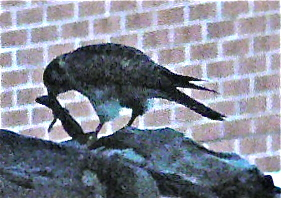
Female American Kestrel With Lizard
MANHATTAN — UPPER EAST SIDE
Images by BEN CACACE
The nesting American Kestrels, on the Upper East Side in the mid 70s, have revealed the presence of lizards on their territory.
Interested in nature with a focus on birding and astronomy. Current project is a visual hunt for novae or exploding stars in the Galaxy from New York City. Got hooked on discovering things while birding and found that the hunt for novae in NYC is right up my alley.
Standard abbr. used for the U.S. (Calif. = California).
2-letter postal codes used for countries (CA = Canada).
Standard abbr. used for the U.S. (Calif. = California).
|
|
2-letter postal code used for the U.S. (MO = Missouri) & for countries (NL = Netherlands).

| [+/-] |
American Kestrel with Lizard 14-Jun-2009 |
The nesting American Kestrels, on the Upper East Side in the mid 70s, have revealed the presence of lizards on their territory.
| [+/-] |
Adult Red-tailed Hawk in Pale Male's Space |
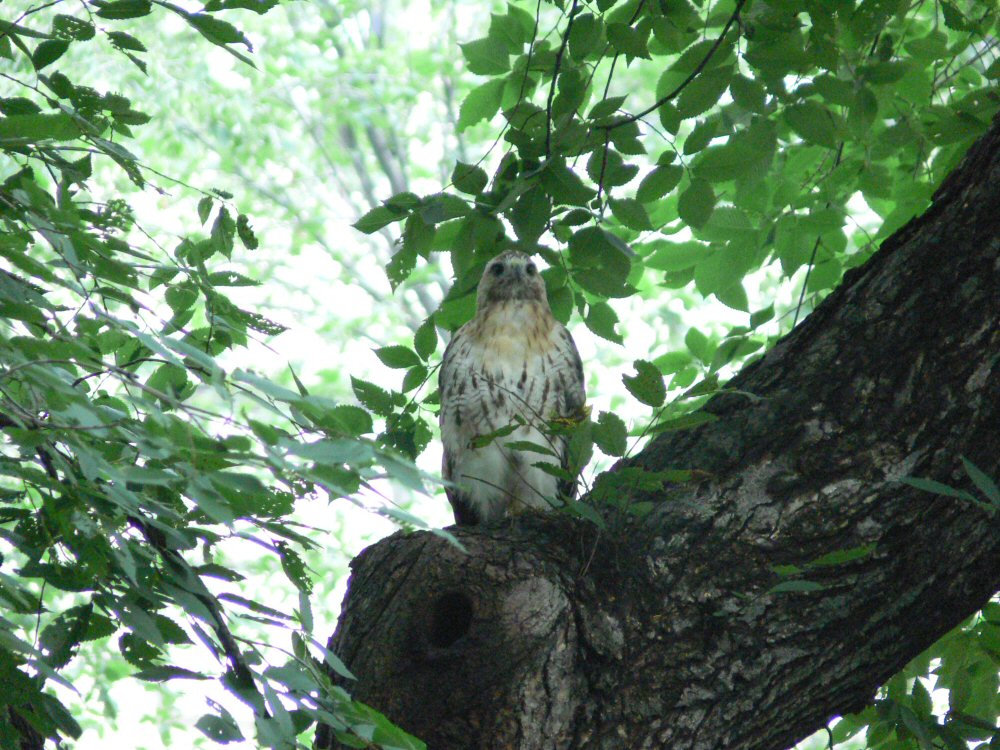
Tonight this adult Red-tailed Hawk was spotted near the north edge of Pale Male's territory. The hawk has a red tail. It was just inside the 85th St. & 5th Ave. entrance. Blue Jays and Robins were making a racket.
| [+/-] |
Scaup Identification Question: 28-Jan-2007 |


This scaup was on the reservoir this morning (Sun, 28 Jan 2007) briefly from at least 9:30a after I completed a loop of the reservoir. I left the area around 9:45a. The bird was not seen again by other birders I mentioned the sighting to.
Are there enough details in the two photos to ID this as Lesser Scaup (Aythya affinis)? The images are cropped from the original without any additional compression other than the normal in-camera JPEG compression.
Thanks in advance and feel free to comment here or via email. See contact information in left sidebar.
| [+/-] |
Birding, Bollywood & Subtitles = Funny! |
Found this bit of comedy by following a link from John's ‘Bird Stuff’ blog talking about the history of birding blogs. His link to ‘SwampBlog’ contains the post ‘ Bollywood Goes Birding‘ which has a link for a short movie clip originally found at ‘George Bristow's Secret Freezer’.
Here's the clip ... Fire it up!
| [+/-] |
Central Park: Juv. Pied-billed Grebe 7-Dec |

This image taken on December 7th at 12:38pm EST at the south end of the reservoir. Focal length in 35mm film equivalent is 420mm, exposure time 1/100s, hand held with image stabilization at f/5.6.
| [+/-] |
Central Park: Northern Pintail 17-Sep |

This image taken on September 17th at 5:42pm EDT under low light conditions. Focal length in 35mm film equivalent was 420mm, exposure time was 1/80s, hand held with image stabilization at f/2.8.
| [+/-] |
Central Park: Sub-adult Red-tailed Hawk |

A young Red-tailed Hawk showed up in Central Park this summer. On the 4th of July this hawk was photographed by Lincoln Karim. Lincoln has posted 10 photos of this one year old hawk which has just started to grow in its adult red tail feathers.
A Red-tailed's juvenile feathers drop out as the adult ones grow in after its first year. Lincoln's photos demonstrate this is a first year hawk and is considered a sub-adult. According to the books, adult plumage is acquired in a hawk's second year. A sub-adult may retain some juvenile wing and tail feathers before its second year molt.
The tail feathers (retrices) of a Red-tailed Hawk are numbered 1 through 6 starting from the center making up a total of 12 feathers. Each feather is paired symmetrically and preceded with the letter ‘r’. The r1 tail feathers are the centermost ones. When the tail is folded these feathers are visible when viewing a hawk from behind. The r6 tail feathers are the outermost ones and are visible on the folded tail when viewing a hawk from the front.
The tail feathers on this hawk, from the 4th of July photos, appears to have only adult r1s & r2s.
A few weeks after Lincoln's photos I spotted this hawk on the 18th, 19th & 23rd of July. At the time of these observations the r1, r2 & r6 tail feathers were red. The r6s were much shorter than the r1s & r2s.
I spotted this hawk again on August 4th which is when I took these photos near Winterdale Arch east of ‘Locust Grove’. In these images both the r3 & r4 feathers have grown in since the 23rd of July. The only juvenile tail feathers appear to be the r5s. Even with binoculars I wasn't able to pick up other juvenile feathers.
Will these r5 feathers remain until this hawk molts again next summer?

Click images for an uncompressed view of the tail

| [+/-] |
Central Park: Juv. Laughing Gull 25-Jul |

The photo was taken on Tuesday, 25-Jul-2006 around 6:50pm at the reservoir. The gulls are both juveniles. The left one is Herring Gull. The right one is Laughing Gull. Both are local breeders around New York City.
The distance to the gulls was around 600 feet based on measurements using Google Earth. The details seen with the 17x doubler through the binoculars (8.5 times 2) exceeds the details in the photos by a hugh margin. The camera's focal length was 420mm (35mm equiv.).
The photo shows the size difference nicely along with the white belly and shape/length of the bill. The scaly appearance of the wings was obvious in the binoculars. This is the first juvenile Laughing Gull I've spotted on the reservoir. Could be I'm trying harder with the gulls this year.
| [+/-] |
Central Park: 30-June-2006 Anhinga |

Click image for a view of the notes
This afternoon I spotted an Anhinga over the reservoir in New York City's Central Park. This is a fairly rare bird to see in the northeast. It was circling very low when I first spotted it and was less than half the width of the reservoir from where I was standing.
This post contains:This observation was submitted to various Internet sites / email lists in order to get the word out so this rare New York State visitor may be seen again and hopefully photographed. My camera, unfortunately, was left at home due to the forecasted thunderstorm.
Here's a copy of my submission sent to various email lists:
Date: Friday, 30 June 2006 (3:25p-10:10p)
Location: Central Park - reservoir & Turtle Pond
Reported by: Ben Cacace
The Anhinga was seen between 4:20p-4:23p along the north edge of the reservoir. The Sun was at my back and the Anhinga was fairly low over the reservoir just east of me. It was gaining height - circling & flapping. The flapping came in bursts from 3 to 5 wingbeats. When the bird held its wings out to glide the wings were just about perfectly level. This effect was more hawk-like than cormorant-like.
From the neck to the bill there was a taper. The bill was thin and there were no bulges from the neck towards the bill. Very elegantly built. Much lighter and more aerodynamic than a cormorant.
The bird was all black. No white was noticed anywhere. No yellow was noticed anywhere.
After circling a few times it headed NE or 'Manhattan North'. Please keep an eye out for this bird. My camera, of course, was at home.
'Bull's Birds of New York State' has the status for Anhinga as 'Casual vagrant':
- Casual: 2 to 6 records
- Vagrant: a species that appears on an irregular basis and whose normal migratory and breeding range does not include New York State
The following was submitted to NYSBirds-L by Angus Wilson (Chair NYSARC) in reference to the Anhinga sighting:
From: Angus Wilson
Subject: [NYSBIRDS-L:3766] RE: NYC, Central Park, Fri. 30-Jun-2006: Anhinga
To: NYSBIRDS-L@cornell.edu
Date: Sat, 01 Jul 2006 17:46:25 -0400
To follow up on Ben Cacace's posting, only two NYS records of Anhinga (Anhinga anhinga) have been accepted by NYSARC.
NYSARC#1992-40-A: one over Central Park, Manhattan, New York Co., 28 April (submitted by Joseph DiCostanzo). This is the first record of the species for New York.
NYSARC#1996-45-A: one at Cornell University Ponds, Unit 2, Town of Dryden, Tompkins Co., 10 June (submitted by Dennis Hasselquist). This is the second record for the state.
This has been a difficult species because most claims have involved birds seen in flight only. Several additional reports may well have been valid but suffered from minimal details and lack of photographic or multi-observer corroboration. I strongly encourage Ben to submit full details of his sighting and if there were any other observers, for them to do likewise. As with any rare bird report, it is imperative to carefully explain how other candidates species (in this case: cormorants, herons and so on) were ruled out.
Obviously, everyone in the metro area should keep a sharp lookout and perhaps check local bodies of fresh or brackish water, preferably with suitable trees and snags!
Cheers, Angus Wilson
New York City & Chair of NYSARC
|
Optics: 8.5x42 binoculars
Distance: Approximately 1,200 feet (0.22 miles) away. Distance determined by Google Earth's distance tool.
Height: when the bird was first seen it was rather low. Probably no more than the height of a 5 or 6 story building. It didn't climb very high before heading in a north-east direction. Only the ventral portion of the bird was clearly seen.
Color: the feathered parts of this bird appeared black from bill to tail. A Double-crested Cormorant always appears to me to be some variation of dark brown — never black. I was looking for patches of other colors on this bird but none were seen. No white was seen anywhere. No yellow patches, like a Double-crested Cormorant, were seen on the face.
Feather condition: since the bird was seen in flight & gliding at times the molt pattern was obvious. No feathers were missing from the trailing edge of the wings or from the tail.
Head & neck: there was a bend in the neck where the neck meets the body. Looking from the neck to the bill the neck became thinner until the bill was reached. I didn't note any color on the bill. Just that the bill appeared long & thin.
Flight: the bird was seen in flight only. It was circling up — flapping & gliding. When the bird set its wings after a short burst of flapping the wings were level like you would see on a Peregrine Falcon.
I stayed awhile after seeing the Anhinga to watch the Double-crested Cormorants in flight. The cormorants overall looked heavy and the cormorants never exhibited level wings when the cormorants occasionally glided. Whenever I've watched D-c Cormorants circling, after taking off from a body of water, the flapping was continous. I've never seen an easy gliding pattern in cormorants like I saw on the Anhinga.
The gliding in the Anhinga was easy and lasted longer than the flapping did. This flight pattern in the cormorants was completely reversed when viewing the cormorants after spotting the Anhinga.
The Anhinga's wingbeats came in bursts of 3—4 flaps with one lasting 5. I counted less than half a dozen flapping sequences. The Anhinga's gliding was effortless which is something I haven't noticed in a cormorant.
Tail: the tail was long. Probably as long as the length of the head & neck. A crude outline of the tail appears on my blog in the image of the field notes which were written down just after viewing the Anhinga.
|
• Anhinga: very small head
|
NYC Area RBA: May 31, 2001: Mon. 28-May-2001, In Central Park [...] certainly the most unexpected report was of a female-type plumaged ANHINGA soaring over the park, going north on Monday.
NYC Area RBA: Sept. 22, 2000: Mon. 18-Sep-2000, Good hawk flights last Monday in the morning along the Westchester coast produced a nice surprise - a female-type ANHINGA, identified as it soared overhead for several minutes in a thermal with a BALD EAGLE and an OSPREY over Playland Park in Rye.
NYC Area RBA: Oct. 2, 1998: Mon. 28-Sep-1998, Certainly startling was the report of a bird believed to be an ANHINGA seen late Monday afternoon by a single observer as it circled over Prospect Park Lake, the bird eventually moving off in a northerly direction.

Standard abbr. used for the U.S. (Del. = Delaware). 2-letter postal codes used for countries (DE = Germany).

